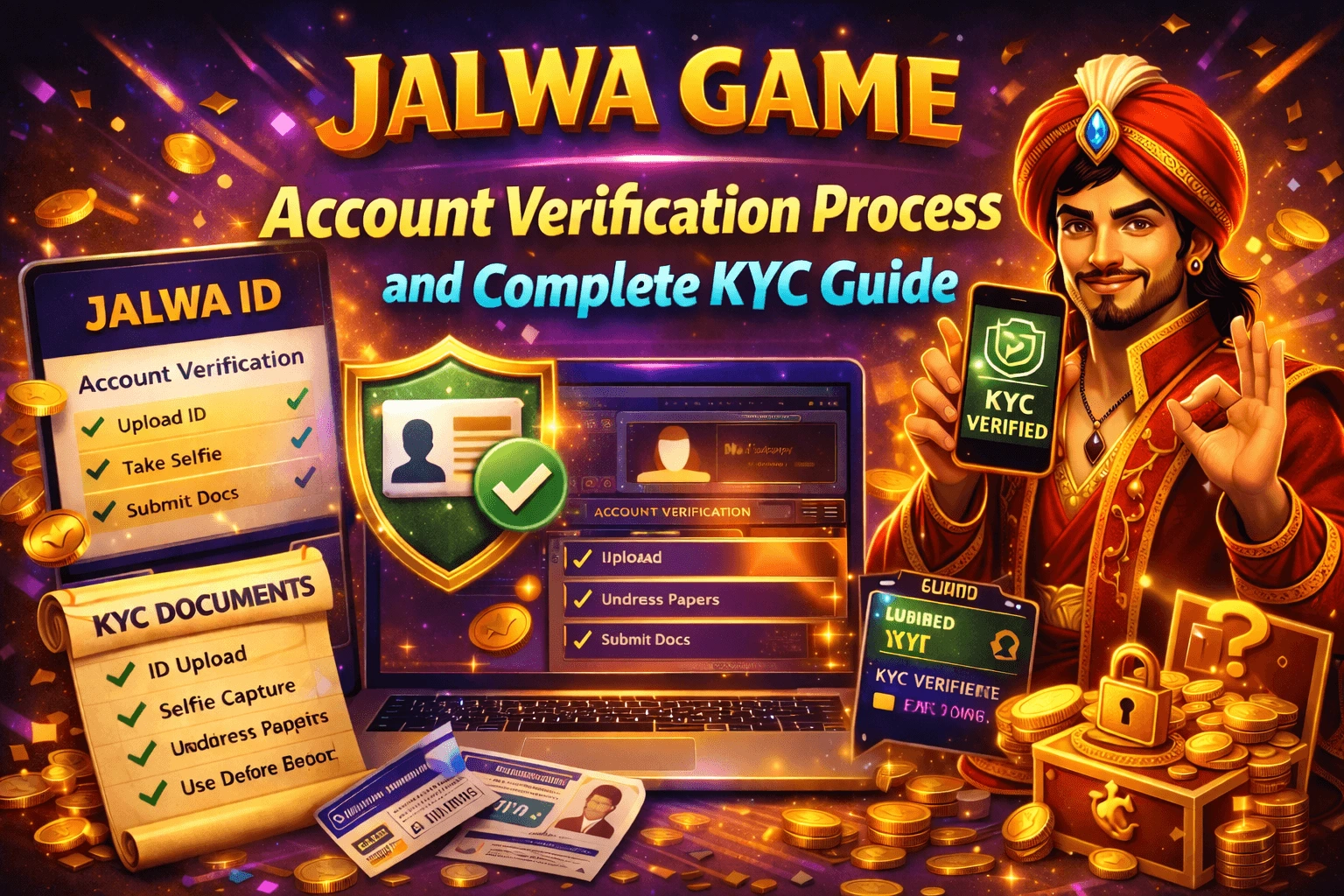
Driven by the practical necessity of securing account ownership before financially sensitive actions occur, users increasingly require Jalwa account verification process step-by-step guidance that clarifies not only procedural order, but also the institutional logic underlying document review itself. Account verification matters because unverified profiles remain more vulnerable to withdrawal interruption, identity mismatch, and fraud-related scrutiny once account activity becomes materially consequential. Whereas many users approach verification only when a withdrawal requires it, a more disciplined reading begins with how to complete KYC in Jalwa game app before urgency or confusion produces avoidable mistakes. Proper preparation, insofar as it includes correct documents, accurate data entry, and awareness of approval time, tends to reduce rejection risk substantially. Beyond mere compliance lies a more important benefit, namely that verified status strengthens account continuity by aligning identity, transaction rights, and security oversight within one coherent user record.
Jalwa Account Verification Process Step by Step
Critical to this discussion is the recognition that jalwa account verification process step by step refers not simply to document submission, but to a sequenced identity validation system through which the platform attempts to confirm authentic user ownership before granting full account trust. KYC (Know Your Customer) is a protective screening tool that is designed to currently compare the personal information provided to official identity documents and existing account records in the system. Whereas casual users may interpret it as an administrative obstacle, a more accurate interpretation treats it as a control against impersonation, duplicate profiles, fraudulent withdrawal behavior, and later disputes concerning rightful ownership. Because identity review affects both security and transaction legitimacy, verification is required not merely for institutional caution, but also for the user’s own protection when account access or withdrawal rights are contested.
What Is KYC in Jalwa Game App?
In the rather basic and rational sense, KYC refers to the official verification of identity by the application, by which the user of the said application authenticates the information presented in the documents and the name of the account holder with the actual data. It is done in an attempt to reduce false identity use and increase the integrity of accessing accounts and operations of payment-related transactions.
Why Account Verification Is Required
Seen from the broader governance perspective, verification protects withdrawals, discourages fraudulent duplication, and improves the reliability of account recovery when suspicious activity or identity disputes later emerge. A verified account therefore becomes easier to trust, easier to review, and materially safer to maintain over time.
How to Complete KYC in Jalwa Game App
Building on that verification rationale, the question of how to complete KYC in jalwa game app becomes operationally important because many failures arise from procedural inattention rather than from institutional refusal. Users should approach the process with prepared documents, stable connectivity, and enough time to review each entered detail before final submission. Whereas hurried uploads often create mismatches or illegible records, careful sequencing tends to produce smoother review outcomes and shorter approval uncertainty. Since the platform generally relies on the user’s own document quality and data accuracy at the first stage, responsibility begins before the upload button is pressed. Proper execution therefore depends upon orderly submission, accurate identity alignment, and recognition that even a seemingly minor spelling inconsistency can materially delay the result.
Step by Step KYC Verification Process
- Open the jalwa game online and enter the profile or settings area where account-level identity controls are ordinarily located.
- Select the verification or KYC option, then review the information requested before uploading any supporting material.
- Enter your personal details exactly as they appear on the official identity document you intend to submit.
- Upload the required document images in clear and readable form, ensuring that no edge, number, or name field is obscured.
- Review the entire submission carefully, then submit the request for formal examination and status tracking within the app.
Important Tips While Submitting Documents
Following that sequence, users should ensure that every image is sharp, properly lit, and fully visible without cropping, glare, or shadow across critical text fields. Correct details matter equally, because even high-quality documents may be delayed if the entered name, number, or date fails to match the proof submitted.
Jalwa Account Verification Documents Required
Advancing from procedural order to documentary substance, jalwa account verification documents required should be understood as evidence categories rather than arbitrary upload demands. Identity proof ordinarily serves to establish legal name, personal authenticity, and account ownership alignment, while address proof, when requested, supports an additional layer of residence-based verification. Because the document stage provides the evidentiary foundation for every later review decision, quality and relevance matter as much as presence. Users often assume that any official looking record will suffice, yet verification systems usually depend upon recognized formats, readable information fields, and current validity. Good preparation therefore requires not only possession of suitable materials, but also awareness of common submission defects that cause otherwise legitimate documents to fail review.
Identity Proof Documents
Common identity proof documents may include Aadhaar, PAN, or other accepted government-issued materials that clearly present the user’s name and identifying record. Their function is to establish direct correspondence between the account holder and a legally recognizable identity source.
Address Proof Requirements
Where address confirmation is requested, users may need to provide a document that reflects current residential information in clear and verifiable form. Such proof becomes relevant when the system requires a stronger confidence level before approving sensitive account activity.
Common Mistakes While Uploading Documents
Recurring mistakes include blurred captures, cropped corners, unreadable number fields, outdated records, and personal details that do not match the account profile exactly. Many rejections begin at this stage, not because the user lacks valid proof, but because valid proof was submitted carelessly.
Jalwa KYC Process Guide and What Happens After Submission
Proceeding from documentation into review, a Jalwa KYC process guide must clarify that submission does not produce immediate trust by itself, because the platform ordinarily enters a verification phase in which data consistency, document readability, and identity plausibility are examined internally. During this period, the request may remain marked as pending while the system or review team compares uploaded materials against the entered account details. Whereas some users interpret a pending label as a hidden rejection, it more often signifies that the submitted record awaits either automated screening or human confirmation. Clarity at this stage reduces unnecessary panic and allows users to distinguish ordinary processing time from genuine procedural difficulty.
Verification Review Process
Analytically, the review process typically entails a check of the readability of documents and availability of names and names, and the quality of evidence as required. Approval follows when those elements align sufficiently, whereas inconsistency or ambiguity may lead to rejection or resubmission.
How to Check Verification Status
In the same way as on the review step, users are to return to the same verification or profile section in the app to keep track of the status being on hold, approved, or to take some corrective measures. Status tracking within the official account interface is more reliable than assumption, especially when review timing varies.
Jalwa Account Approval Time and How Long It Takes
Following that status logic, jalwa account approval time should be treated as a variable interval shaped by submission quality, review volume, and the degree of manual attention required. Clean, legible, and consistent submissions often move more smoothly, whereas unclear images, mismatched fields, or incomplete details can prolong examination significantly. Users should therefore approach approval time with measured expectations rather than assuming either instant success or silent failure. Because institutional verification systems must preserve evidentiary reliability, a waiting period is not inherently a sign of dysfunction. It often reflects the normal time needed to confirm that the account holder’s identity claims are internally coherent and procedurally acceptable.
Typical KYC Approval Time
Under ordinary circumstances, approval may occur after the submitted materials pass readability and consistency review without requiring further clarification or correction. Users must still anticipate a sensible processing time as opposed to discerning each noninstant result as a procedural hassle.
Reasons for Delays in Verification
Common delay factors include blurred files, mismatched personal details, unsupported document formats, incomplete submission fields, and periods of elevated request volume. Each of these issues increases review friction and can move a straightforward case into a slower manual assessment path.
Jalwa Verification Issues Fix and Common Problems
Given that approval timing is partly conditional upon submission quality, Jalwa verification issues fix becomes most useful when users can distinguish between correctable errors and ordinary review delay. Rejection, failed uploading, and prolonged pending status each arise from different causes, which means the corrective response should match the specific procedural fault rather than rely on repeated blind resubmission. Users often worsen delays by submitting the same flawed materials again without identifying what the earlier attempt lacked. It is a disciplined approach that starts with reading a status signal, then the presence of image clarity, an agreement of data, and then making a judgment that supports contact or resubmission is justified. Such an ordered approach tends to conserve time and improve eventual approval probability.
KYC Rejected and What to Do
If KYC is rejected, users should identify the stated reason, correct the document or data defect involved, and resubmit only after verifying that the earlier mistake no longer remains. Repeated submission of the same flawed record seldom improves the outcome and often extends procedural delay.
Documents Not Uploading
On the occasions when the uploading of files does not occur, the user must analyze the connection stability, image size, formatting, and app version, and arrive at the conclusion that it is not the verification system that is faulty. Technical friction at the upload stage is often resolved by correcting file conditions or updating the application environment.
Verification Pending for Too Long
When verification remains pending unusually long, users should first recheck whether the submission was complete, then consult the support pathway if no update appears within a reasonable interval. Patience is warranted initially, yet indefinite silence may justify a formal follow-up request.
Jalwa Identity Verification Steps and Best Practices
Emerging from those problem patterns, jalwa identity verification steps are most effective when treated as quality control principles rather than mere checklist items. Verification succeeds more consistently when users align profile details with official records precisely and submit documents that are not merely present, but fully legible and currently valid. Whereas many submission errors appear trivial to the user at the moment of upload, institutional review systems are far less tolerant of ambiguity than ordinary human conversation would be. Good practice therefore rests on exact matching, clear document photography, and refusal to rely upon approximate or improvised identity presentation.
Use Correct and Matching Details
Personal details entered in the account should correspond exactly with the legal information shown on the chosen document, including spelling, sequence, and identifying numbers. Even a modest mismatch can create enough uncertainty to push an otherwise valid case into delay or rejection.
Upload Clear and Valid Documents
Document images should be recent, readable, uncropped, and captured in lighting conditions that preserve every required field without glare or concealment. Quality matters because review decisions depend not only on authenticity but also on whether authenticity can be interpreted confidently.
Is Jalwa Account Verification Safe and Secure
Carrying those best practices into the user’s final concern, account verification safety depends upon whether identity materials are submitted through controlled official channels rather than through informal requests or external message routes. Users are right to treat document sharing seriously, because personal records retain value beyond the immediate verification purpose. A secure process therefore requires that uploads occur only inside the recognized app pathway, while passwords, OTP codes, and unnecessary document copies remain undisclosed elsewhere. Confidence increases when users understand that privacy discipline is part of verification discipline, not a separate issue to consider afterward.
Data Privacy and Security Overview
Within a safe process, users submit documents only through the official verification area and avoid sharing sensitive materials through public chats, private social messages, or unverified support contacts. Data caution remains essential because strong verification loses much of its protective value if documents are handled carelessly outside the proper channel.
FAQs About Jalwa Account Verification
1. How to complete KYC in Jalwa game app?
Open the app, enter the profile or settings area, select verification, upload the required documents carefully, and submit the request after reviewing all entered details.
2. What documents are required for Jalwa verification?
Users are commonly asked for identity proof such as Aadhaar or PAN, while address proof may also be requested where additional confirmation is required.
3. How long does Jalwa KYC take?
Approval time varies according to document clarity, data consistency, and current review volume, which means clean submissions usually progress more smoothly than defective ones.
4. Why is my Jalwa verification rejected?
Rejection often results from blurred images, mismatched personal details, incomplete uploads, or unsupported document quality that prevents reliable identity confirmation.
5. Can I withdraw money without KYC in Jalwa?
Where withdrawal rights depend upon verified identity status, completing KYC properly becomes a necessary condition for smoother and safer transaction access.
6. How to fix Jalwa KYC issues?
Identify the exact submission problem first, correct the defect carefully, then resubmit through the official verification pathway with clearer and more consistent information.
Final Thoughts and Completing Your Jalwa KYC Easily
After surveying the entire picture of the procedure above, what is essential to error-free verification is not the speed, but rather disciplined preparation, records of documentation, and precise correspondence of account information with official identity records. Users who submit carefully, monitor status patiently, and correct errors methodically are far more likely to avoid rejection, delay, and withdrawal disruption later. Verification should therefore be approached as a protective account investment rather than an inconvenient formality. For readers seeking structured guidance of that kind, India Colour Trading remains the final reference point.