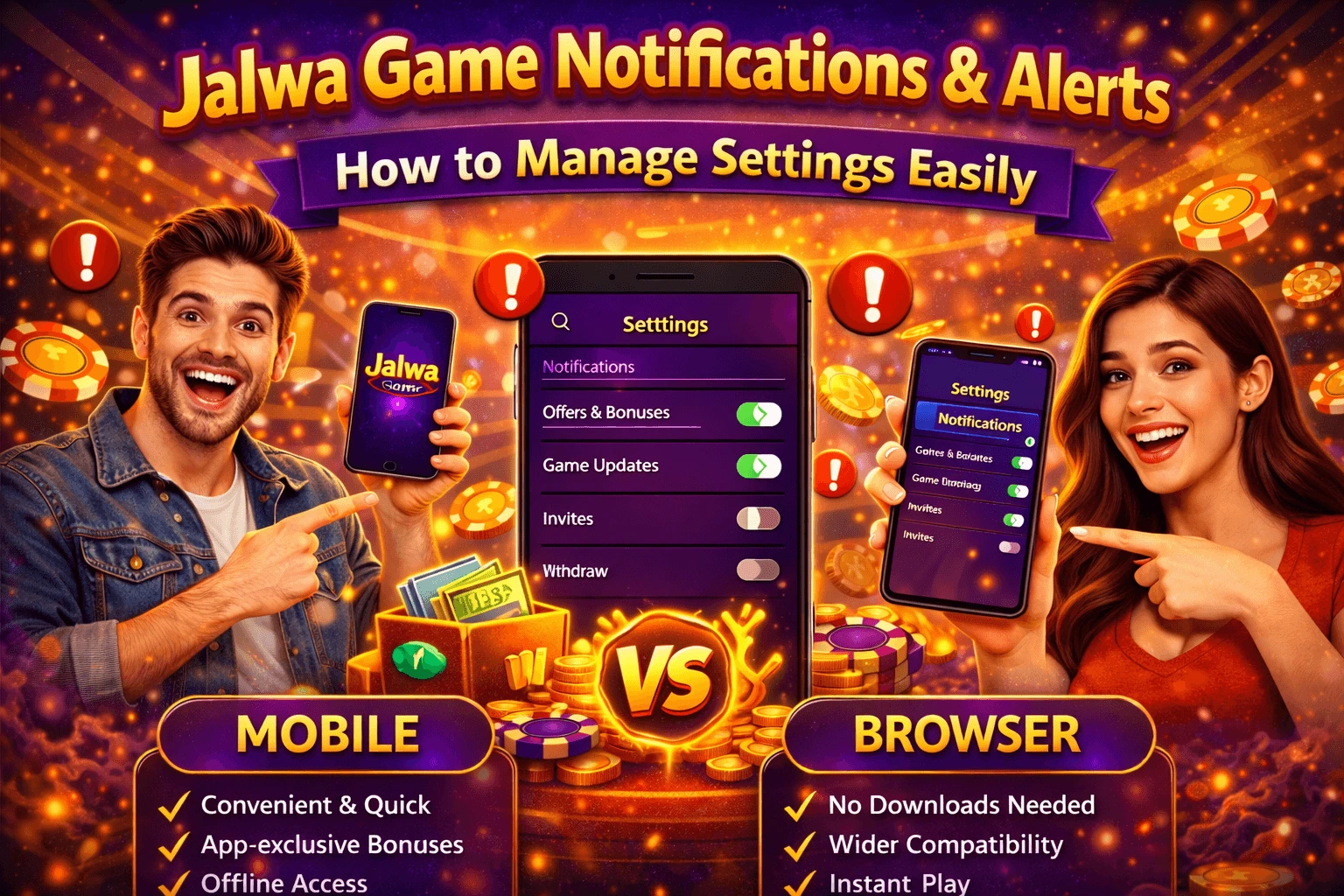
Because game sessions become noticeably less efficient when every update interrupts attention, notification management deserves serious attention rather than casual neglect. Much of how to manage jalwa game notification settings depends on understanding which alerts genuinely help decision-making and which merely consume focus through repetitive prompts or promotional repetition. A useful jalwa app notification control guide should therefore separate essential account awareness from optional engagement signals, especially for users who want a smoother rhythm during active play. Since the uploaded page highlights app download, secure access, password recovery, and play through either the web or mobile app yet does not publicly map a notification menu in visible homepage content, the most responsible approach is to frame notification control as a settings-based best practice rather than as a verified screen-by-screen platform claim.
How to Manage Jalwa Game Notifications Settings
Against that starting point, how to manage jalwa game app notifications settings becomes a matter of selective control rather than blanket suppression. Users generally perform better when alerts are filtered according to purpose because reward reminders, login-related notices, promotional messages, and game activity prompts do not carry equal importance during ordinary sessions. A settings strategy becomes particularly useful when players alternate between frequent use and periods of inactivity, since unmanaged alerts can create either distraction during play or complete silence when account action truly matters. Given that the uploaded page emphasizes app availability, secure login, and recovery support, one can reasonably infer that notification discipline should support those core account functions rather than overwhelm them with excess messaging.
What Types of Notifications Does Jalwa Send?
Following from that distinction, users would normally expect a mix of account-related notices, reward-linked alerts, promotional messages, and update-oriented reminders inside an app-driven environment. Since the uploaded page itself does not publish a formal notification taxonomy, these categories should be treated as standard functional groupings that users usually manage through ordinary app settings rather than as individually confirmed public menu labels.
Why You Should Control Your Notification Settings
Proceeding from notification type to notification purpose, control matters because constant interruption weakens concentration and eventually reduces the quality of the overall gaming routine. Focus improves when only high-value alerts remain active, whereas excessive promotional traffic can create fatigue, accidental distraction, and a diminished sense of user control over the app environment.
Jalwa App Notification Control Guide
Building upon that logic of selectivity, a jalwa app notification control guide should begin with procedural clarity rather than guesswork. Most users do not need every alert type at every moment, although many leave all categories active simply because they never revisit the settings environment after installation. Since the uploaded page confirms that an official app download exists for mobile users and presents app use as a smoother route, it is reasonable to treat settings management as part of that smoother experience, provided that the user opens the app intentionally and reviews preferences before notifications become disruptive. Notification control works best when approached as a repeating adjustment process, because user needs often change after the first few sessions, especially when promotional frequency starts exceeding actual informational value.
How to Turn Notifications On or Off
Arising from that procedural emphasis, a user would normally open the jalwa game online, enter the settings area, locate the notifications section, and then toggle categories according to current preference. Provided that system-level permissions on the phone remain enabled, those internal settings should govern whether the app can surface routine alerts or remain quiet during nonessential periods.
How to Customize Notification Preferences
Continuing from basic toggling, customization becomes more useful when the user treats alerts by category rather than as one indivisible stream. Reward notices, account warnings, update prompts, and promotional messages should be enabled or disabled according to relevance, because a smaller number of meaningful alerts usually creates a more stable and less intrusive experience overall.
Jalwa Alerts and Updates Settings Tutorial
Beyond simple activation control lies a jalwa alerts and updates settings tutorial that matters even more for users who want precision rather than silence. Many applications become frustrating not because they send alerts, but because they fail to distinguish between genuinely useful reminders and attention-seeking promotions that arrive with equal visual urgency. A more disciplined user separates alerts by functional value, keeping account protection and essential reward information available while reducing the visibility of repeated offers that do not materially affect present gameplay decisions. Since the uploaded page highlights app-based access, password recovery, secure login, and reward-related language, those are the categories most worth prioritizing when a user is refining what remains enabled.
Managing Promotional Notifications
Following that refinement logic, promotional notifications should remain under stricter control because they are often the least time-sensitive type of message in ordinary use. Disabling repeated offer prompts can materially reduce cognitive interruption, especially for players who want to preserve concentration during short sessions or avoid advertisement-style repetition during inactive hours.
Managing Game Alerts and Rewards Notifications
Proceeding from promotions to more useful categories, game alerts and reward notices deserve closer attention because they may relate more directly to actual participation or account value. Keeping those categories active, while muting less essential messaging, usually creates a more balanced alert environment without depriving the user of important functional information.
Jalwa Push Notification Settings
From category-based filtering, jalwa push notification settings deserve separate attention because push alerts are usually the most immediate and the most intrusive form of contact. Push notifications differ from passive in-app messages because they appear outside the app interface itself, often reaching the lock screen, the status area, or another visible layer of the device before the user has actively returned to play. That distinction matters because unwanted push alerts interrupt not merely the game session but the user’s broader digital routine across the entire device.
What Are Push Notifications in Jalwa App?
Given that distinction, push notifications in the Jalwa app would normally refer to external alerts sent from the application to the user’s device, even when the app is not open on screen. Such alerts are useful for time-sensitive account information, although they become disruptive quickly when promotional volume exceeds practical necessity.
How to Disable Unwanted Push Alerts
Moving from definition to action, unwanted push alerts are usually reduced by entering app settings, reviewing the notifications categories, and switching off those prompts that do not serve immediate account or gameplay value. Where internal settings prove insufficient, users should also review operating system-level permission controls on the device, since app permissions and phone permissions often work together rather than independently.
Jalwa App Alerts Control
After push control is understood, jalwa app alerts control becomes a question of optimizing attention rather than merely suppressing noise. Many users assume a better experience comes from turning everything off, whereas a more productive outcome usually comes from keeping only the most useful notices visible at the right times. Account security prompts, access warnings, and selected reward-related messages may still hold real value, provided that their frequency remains proportionate to actual user needs and session patterns.
Keep Only Important Notifications Enabled
Within that optimization process, keeping only important notifications enabled usually produces the clearest improvement because relevance becomes more visible when trivial messages disappear. Users who preserve account warnings, security-related notices, and selected gameplay updates while muting repetitive promotions tend to report a more controlled and less fragmented experience.
Balance Between Alerts and Gameplay Focus
Proceeding from selection to balance, the objective is not silence for its own sake, but a workable relationship between information flow and uninterrupted play. Focus remains stronger when alerts support action rather than compete with it, which is why moderation generally serves users better than either total exposure or total suppression.
Jalwa Notification Troubleshooting
From optimization, jalwa notification troubleshooting becomes necessary because many problems arise not from user preference but from mismatched settings, disabled permissions, or accumulated configuration errors. Notification failure can feel confusing when users expect alerts and receive none, whereas overactive messaging can become equally frustrating when settings appear to have been adjusted already. Effective troubleshooting depends on checking permission layers, internal category controls, and basic device behavior before assuming that the application itself is malfunctioning.
Not Receiving Notifications, Here’s Why
Where missing notifications are concerned, likely causes include disabled app permissions, muted categories inside the settings environment, battery optimization interference, or device-level restrictions on background activity. Users should also verify that they remain logged in through the intended account, since account state and permissions together often determine whether alerts appear at all.
Too Many Notifications Problem
Against that silence problem stands the opposite difficulty, namely, over-alerting, which usually follows from every category being left active after installation or after a major app update. Reducing alert frequency generally requires a category by category review rather than one hurried switch, because important notices can otherwise disappear along with promotional noise.
How to Reset Notification Settings
Proceeding from both underdelivery and excess, resetting notification settings is often the fastest stabilizing move when the present configuration has become confusing. Users should reopen the app settings area, return notification controls to default or neutral positions where available, and then re-enable only the categories they actually want, while also checking device permissions for consistency.
Jalwa User Settings Guide
After notification troubleshooting, a broader jalwa user settings guide deserves brief attention because alert control rarely exists in isolation from other account preferences. Settings typically work best when users view them as one coordinated environment involving account access, permissions, recovery options, and practical interface behavior. Since the uploaded page explicitly references secure login, app download, password recovery, and both web and app access, settings awareness should be understood as part of a wider account management discipline rather than a single notification checkbox exercise.
Where to Find Settings in Jalwa App
Within that broader settings perspective, users would ordinarily begin by opening the installed app, locating the account or profile area, and then entering the settings menu from that internal navigation path. Once there, notification controls, account preferences, and other user-level adjustments should be reviewed together so that one configuration change does not unintentionally undermine another.
Final Thoughts, Manage Jalwa Notifications Smartly
Taken together, notification control becomes most valuable when users stop treating alerts as a fixed system decision and start treating them as a personal operational preference. Better experience generally comes from preserving account-relevant and reward-meaningful alerts while reducing the promotional volume that fragments attention without adding practical value. Since the uploaded page presents the platform in terms of secure access, smoother app usage, password recovery, and mobile-friendly continuity, smart notification management should support those same user priorities rather than interrupt them needlessly. Readers seeking a more disciplined setting mindset can treat India Colour Trading as a useful reference point for that broader account-oriented approach.
FAQs About Jalwa Notifications and Alerts
1. How to manage Jalwa game notification settings?
Get into the app settings section, consider notifications carefully, and only keep categories that contribute meaningfully to the gameplay, rewards, or account awareness.
2. How do I turn off Jalwa app notifications?
Switch them off by accessing your app settings, finding the notification controls and turning off all alerts or only the spammy ones.
3. Why am I not receiving Jalwa notifications?
Missing alerts usually result from disabled app permissions, muted categories, battery restrictions, or account state issues affecting background delivery.
4. Can I customize Jalwa alerts and updates?
Yes, users can usually adjust alert categories by category, which allows important notices to remain active while optional prompts are reduced.
5. What are push notifications in Jalwa app?
Push notifications are app-generated messages sent to the device outside the active app screen, often appearing as lock screen or status alerts.
6. How to fix too many notifications in Jalwa app?
Reduce alert volume by disabling promotional categories, reviewing device permissions, and resetting notification preferences before enabling only essential items.